

In this article, Head of Research and Investment Strategy Hans Stegeman explains the essence of Triodos Investment Management’s approach to identifying and solving these difficult to navigate challenges through investments in listed equities and bonds.
Our recently published whitepaper 'Impact investing through listed equities and bonds' explores how achieve impact at the scale and pace needed to move the needle by investing in listed companies.
Beyond reform – transition and transformation
“Over the last few years, a series of highly ambitious goals have made their way into public eye. In 2015, the Paris Climate agreement was a landmark achievement, and the introduction of the UN Sustainable Development Goals gave world leaders a roadmap for a more sustainable society.”
Stegeman continues, “To be successful in achieving these, however, we must embrace radical transformation. Our system can no longer exclusively pursue economic expansion and financial return. We must transition towards a sustainable system that respects our planet’s ecological balance and works for the benefit of all.”
“All we need is courage and capital. The courage to make radical choices, the capital to mobilise them – financial capital, human capital, intellectual capital, natural capital, social and manufactured capital. We cannot be content with merely reducing the collateral damage of our current model. Instead, we must build a regenerative system that paves the way for a sustainable, circular and inclusive society.”
Beyond ESG – what sets Triodos IM apart
Company sustainability ratings and exclusion approaches have been instrumental in facilitating swift market adoption of ‘do no harm’ and environmental, social and governance (ESG) optimisation strategies. “With ESG we are moving in the right direction”, explains Stegeman, “but few realise that these approaches are ineffective at steering capital toward companies that bring sustainable, economically viable, solutions into the marketplace. We need to quicken our pace. It is not enough to invest in best-in-class companies which, within their sector, perhaps belong to the least polluting. For a truly sustainable future, we must invest in those companies that actively contribute to a healthy planet and inclusive societies.”
“ESG and exclusion focused funds, which make up the overwhelming majority of the market’s ‘sustainable investment’ options, eliminate companies from an index using quantitative ESG thresholds, sector-wide screens, or norm-based exclusions to be left with ‘no harm done’ or ‘best-in-class’ portfolios. This means that at no point during the investment process, a company’s positive contribution to society is considered.”
Our impact equity and bond funds go beyond conventional ESG-approaches to invest for positive change.
Investable transition themes
“Our impact equity and bond funds go beyond these conventional approaches to invest for positive change. We have defined seven themes that are instrumental in the transition to a sustainable future, and that guide our portfolio construction. Our company selection focuses first and foremost on including the real innovators and drivers of sustainability.”
“We follow an inclusionary, bottom-up, investment process that puts positive impact at the center of stock and bond selection”, says Stegeman. “Every investment in our portfolio must materially contribute to at least one transition theme through its products, services, and/or business operating models. Additionally, to be eligible for investment, companies must meet our industry leading process, product and precautionary minimum standards.”
“Once companies are deemed eligible for investment, integrated financial and sustainability analysis is conducted to determine whether companies qualify as portfolio candidates”, he continues. “We evaluate the company’s financial value drivers and assess the potential impact of internal and external sustainability factors on future financial value, making our approach both solutions-focused and forward-looking.
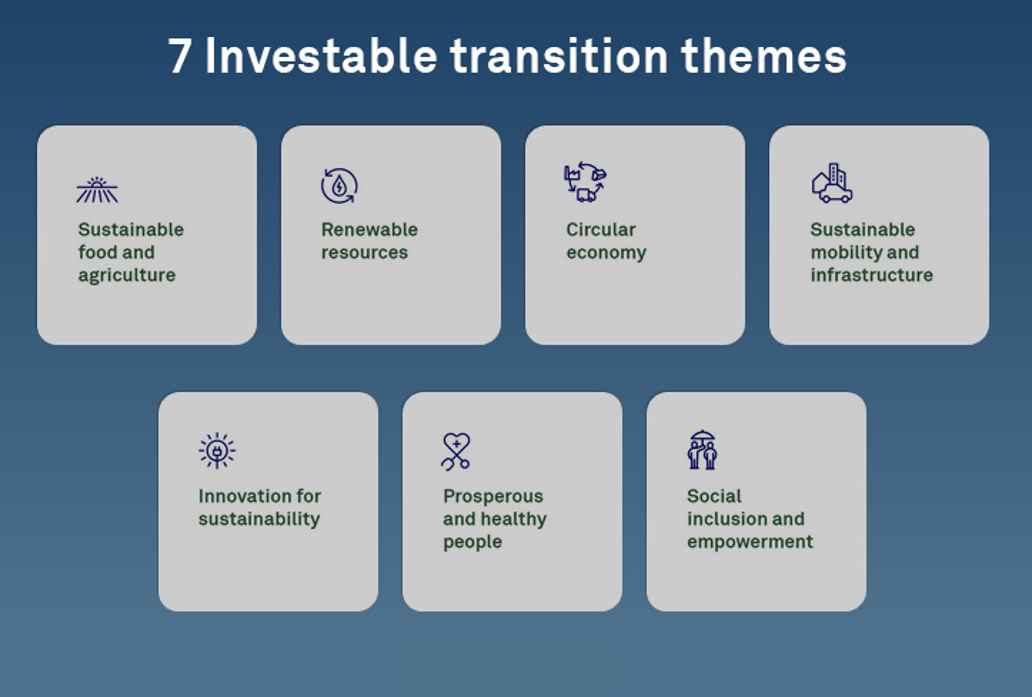
Our transition themes and the SDGs
“Obviously, there are natural links between the SDGs and our seven transition themes”, says Stegeman. “They address the same topics that are key to achieving the underlying SDG sub-goals. Our role as an investor, though, is a different one. While the SDGs primarily help governments set policy priorities up through 2030, our transition themes aim to sustain positive development beyond this timeline and represent a holistic view of investable solutions.”
“Sustainable transition solutions can be very nuanced and technical and, yes, sometimes pose a dilemma. Our analysts and fund managers therefore thoroughly challenge companies and their products to ensure alignment with our core vision on sustainability. Food scarcity, for example, is a major challenge, and there are various ways to consider solving this. One way could be by increasing crop yields through genetically modified organisms (GMO). Given the negative impact of GMO on biodiversity, however, our answer would be to reduce food waste, thus satisfying a substantial part of the demand without requiring additional input.”
“Current global trends determine the challenges for tomorrow”, concludes Stegeman. ”By steering capital in the right direction, we can bend those trends, and turn toward a more sustainable future.”
Read our whitepaper 'Impact investing through listed equities and bonds' and discover how you can make impact.